The control layer
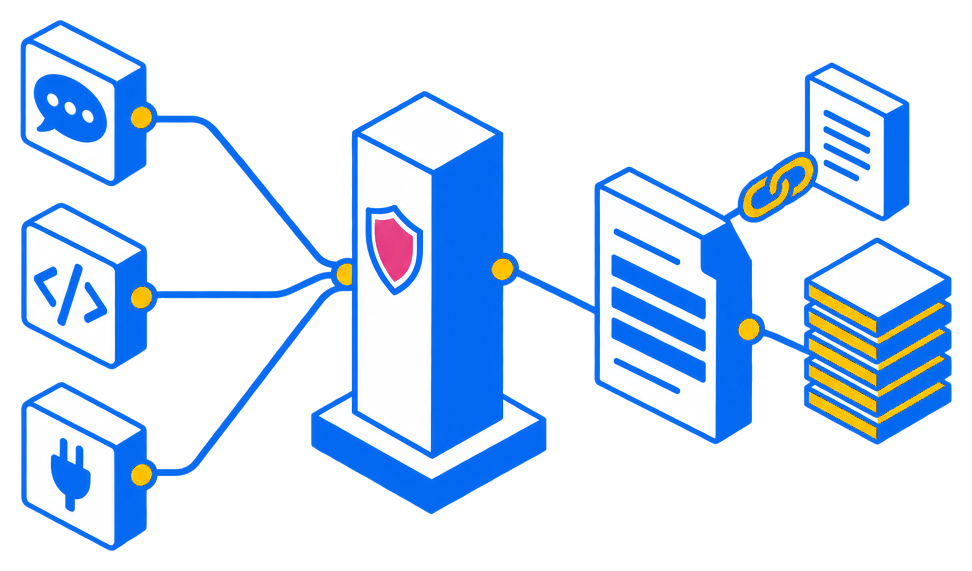
A control layer sits between your organisation and AI. It applies what your organisation has decided: what information AI can use, which rules apply and what agents may do, and it records every decision.
- /01Your AI
 Copilot
 ChatGPT
 Claude
- Answers
- Actions
- /02The layer in between
Relevant is not the same as applicable.
- Authority
- Permission
- Applicability
- Evidence
- Action control
- /03Your sources
 SharePoint
 Confluence
 Teams
 Slack
 Google Drive
 PostgreSQL
Decide first
AI can find information. A control layer decides whether that information applies, whether this user or agent may see it, and whether an action is allowed. A good control layer can itself be checked, which is why Gluon’s code is open source.
- /01What can AI trust?Which information is current, authoritative and applicable.
- /02What can AI access?Existing permissions stay in force, for people and for agents.
- /03What can AI do?Actions are allowed, blocked or sent to a person for approval.
What actually applies
A language model picks whatever looks most like the question. Your organisation runs on what has been adopted and is in force. The gap between the two widens once agents start to act.
- A newer document can be a draft.Recent is not the same as adopted.
- An approved policy can apply to the wrong country.Scope decides who a rule is for.
- An agent can reach information it should never touch.An agent needs the limits of the person it works for.
The jobs
What applies, who may see it, what may happen, and a record of all of it.
- /01Source authorityKnow which source is authoritative.
- /02ApplicabilityWork out what applies to this person and moment.
- /03PermissionsEnforce the rights that already exist.
- /04Action controlAllow, block or escalate every action.
- /05EvidenceRecord what each answer and action was based on.
- Authority Graph
 A trust level per source, evidence authority, conflicts shown.
- Applicability Engine
 Scope, status and validity from the model.
- Permission Engine
 One policy decision point, mirrored source rights.
- Action control
 Approval rules, autonomy levels, a kill switch.
- Evidence Engine
 Citations, lineage and a hash-chained audit trail.
The layer between
A control layer does not replace the tools you already use. It decides what they may use and do.
- Not a language modelIt does not generate answers. It decides what your model may use, and you can swap the model.
- Not a search engineSearch finds what is relevant. A control layer decides what is applicable.
- Not an output filterA filter on the output cannot see which source was used. A control layer decides before information reaches the model.
- Not a policy on paperAn AI policy in a document changes nothing about what an agent does. A control layer applies it to every question and action.
Around retrieval
Gluon first checks which sources have authority, which version applies and whether this person may see it. Retrieval then works only on that context, and the decision is recorded.
| RAG on its own | With Gluon | |
|---|---|---|
| The engines | The passages closest to the question, whatever their status. | Only the version in force, for this person, this team and this moment. |
| Authority Graph | Two sources that disagree are blended into one answer. | The authoritative source prevails, and the conflict stays visible. |
| Permission Engine | The rights of the index, if any. | The source’s own rights, with their age checked, and your policies and markings on top. |
| Action control | Nothing about what an agent may do. | Every action gets a verdict before it runs. |
| Evidence | A list of retrieved chunks, if anything. | A decision trail with source, version, permissions checked and what was left out. |
| Drift | Measured once, in the demo. | Golden questions run again and live answers are sampled, per deployment. |
See it yourself
Start with one use case, one source boundary and one team.
More explainers
- ExplainerFour questions for every AI vendorSovereignty is not where a server sits. It is whether you stay in control. Put these four questions to every AI vendor, including us.
- For executivesGluon for executivesYou can explain every decision your AI takes: to your board, to the regulator and to yourself. And you keep the freedom to leave.