When a record is deleted in a source system, its connector reports the delete to Gluon. Gluon hides the record before the report's response returns and purges it within 24 hours: from the index, from the chat answers that quoted it and from the encrypted audit payloads of those conversations. The audit metadata stays, so you can prove the deletion happened.
Pick what a delete does
Each Source declares deletes in its GOL file:
| Value | What happens |
|---|---|
propagate (the default) | hidden at once, then purged |
tombstone | hidden at once and kept hidden; the source can bring it back |
ignore | nothing changes; the report is still audited |
Report a delete
The connector calls the Source's delete route with an API token that carries the scope connector:deletes:<source name>. A token is bound to the Sources it may delete from.
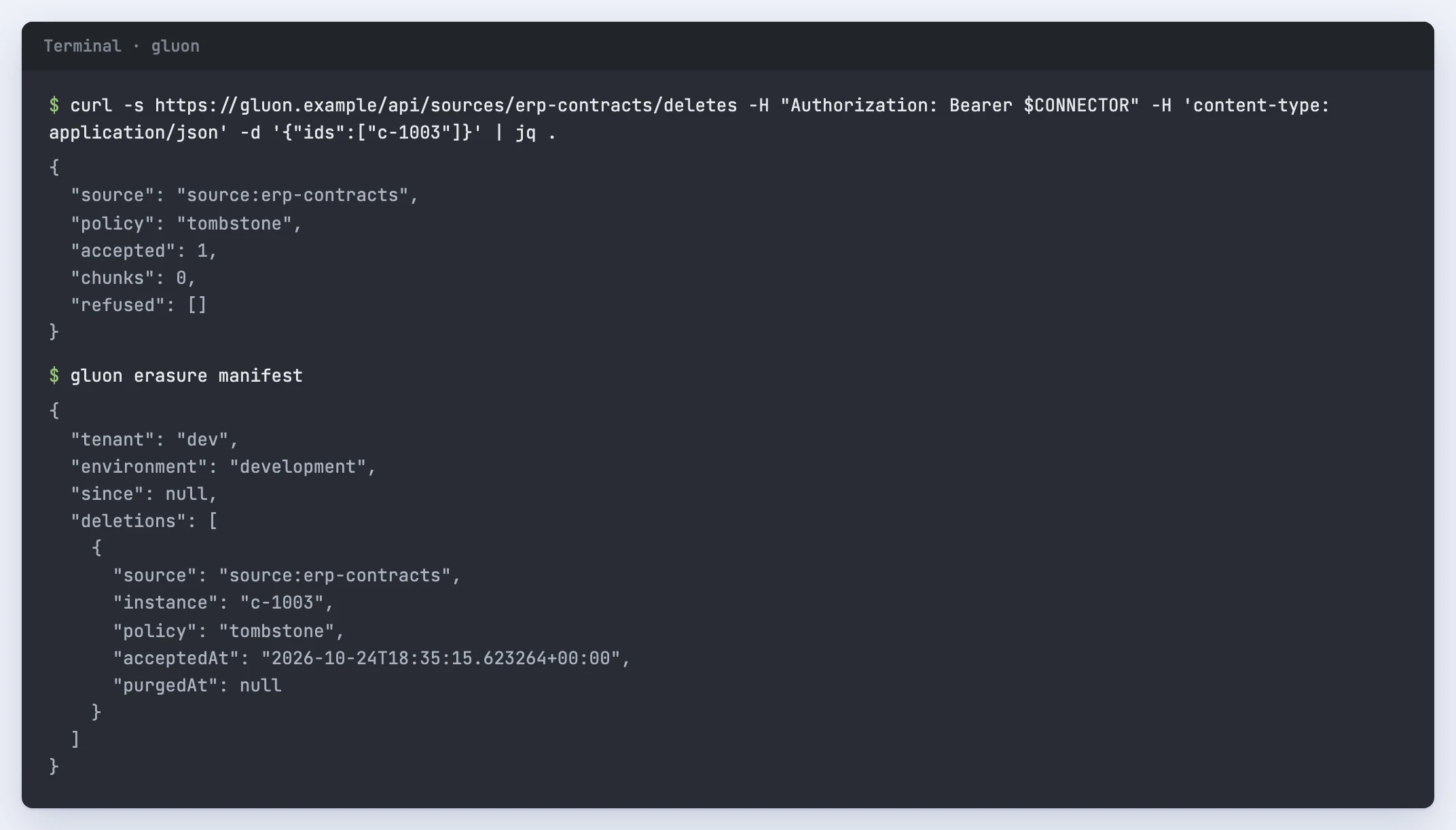
curl -s https://gluon.example/api/sources/erp-contracts/deletes \
  -H "Authorization: Bearer $CONNECTOR" -H 'content-type: application/json' \
  -d '{"ids":["c-1003"]}'
The response names the source, its policy, how many instances were accepted, how many chunks went with them and which ids were refused. An id the store holds from another Source is refused, so one connector can't delete another's records. A report takes at most 10,000 ids. You get 401 without a valid token, 403 without the scope for that Source, 404 for an unknown Source and 422 for malformed ids. Each report is audited as instance.delete with the ids and counts, never the content.
The purge
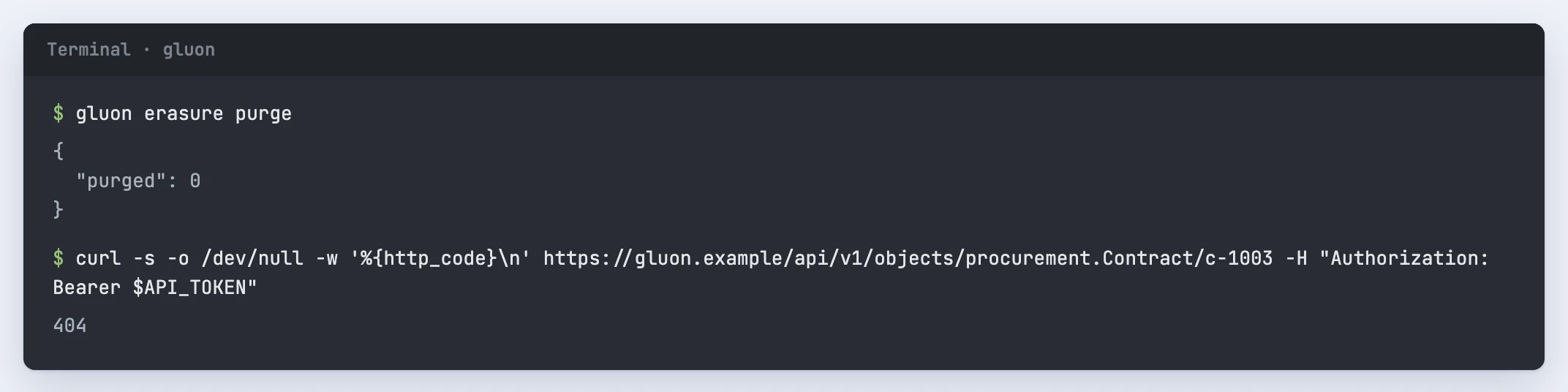
The worker runs erasure.purge every hour, which leaves room for a day of failed runs inside the 24-hour target. You can also run it by hand:
gluon erasure purge
It prints {"purged": n}. For each propagate delete not yet purged, it:
- Removes the instance and its chunks from the store, leaving an id-only hidden marker with no text, vector or properties.
- Replaces every claim in a stored chat answer that cited the record with "[removed: a source record this answer cited was deleted]", along with the uncited claims of the same answer, and drops the record from the answer's evidence.
- Erases the encrypted audit payloads of those conversations, and of API, MCP and shadow answers that retrieved the record.
- Writes an
instance.purgeaudit record.
The hidden marker stops a late reindex from bringing the record back. A write whose read time at the source is earlier than the tombstone, or that carries no read time, stays hidden. A record re-created at the source comes back only when its connector sends a read time after the tombstone.
Legal holds
A security officer (any role granting manage-security) puts a conversation on hold:
curl -s -X POST $GLUON/api/chat/conversations/$CONVERSATION/hold \
  -H "Authorization: Bearer $TOKEN" -H 'content-type: application/json' -d '{"on": true}'
While the hold is on, the owner can't delete the chat ("A legal hold applies to this chat, so it cannot be deleted.") and a purge keeps the conversation's audit payloads, naming them in its result. The purge still blanks the quote in the stored answer. Send {"on": false} to lift the hold. Both changes are audited as chat.legal-hold.
Check the result
gluon erasure manifest
The manifest lists each deletion by source, instance, policy, acceptedAt and purgedAt, identifiers and times only. A purgedAt of null means the purge hasn't reached it yet, or the policy is tombstone. Ask a question that used to cite the record: the answer no longer does.
Two places sit outside the purge. A Mac running the desktop assistant keeps a deleted title in its recognition pack until its next pack refresh, which the Mac checks every hour. Your model provider's own copy needs the manifest sent to them; Gluon produces it and does not send it.